
Introduction
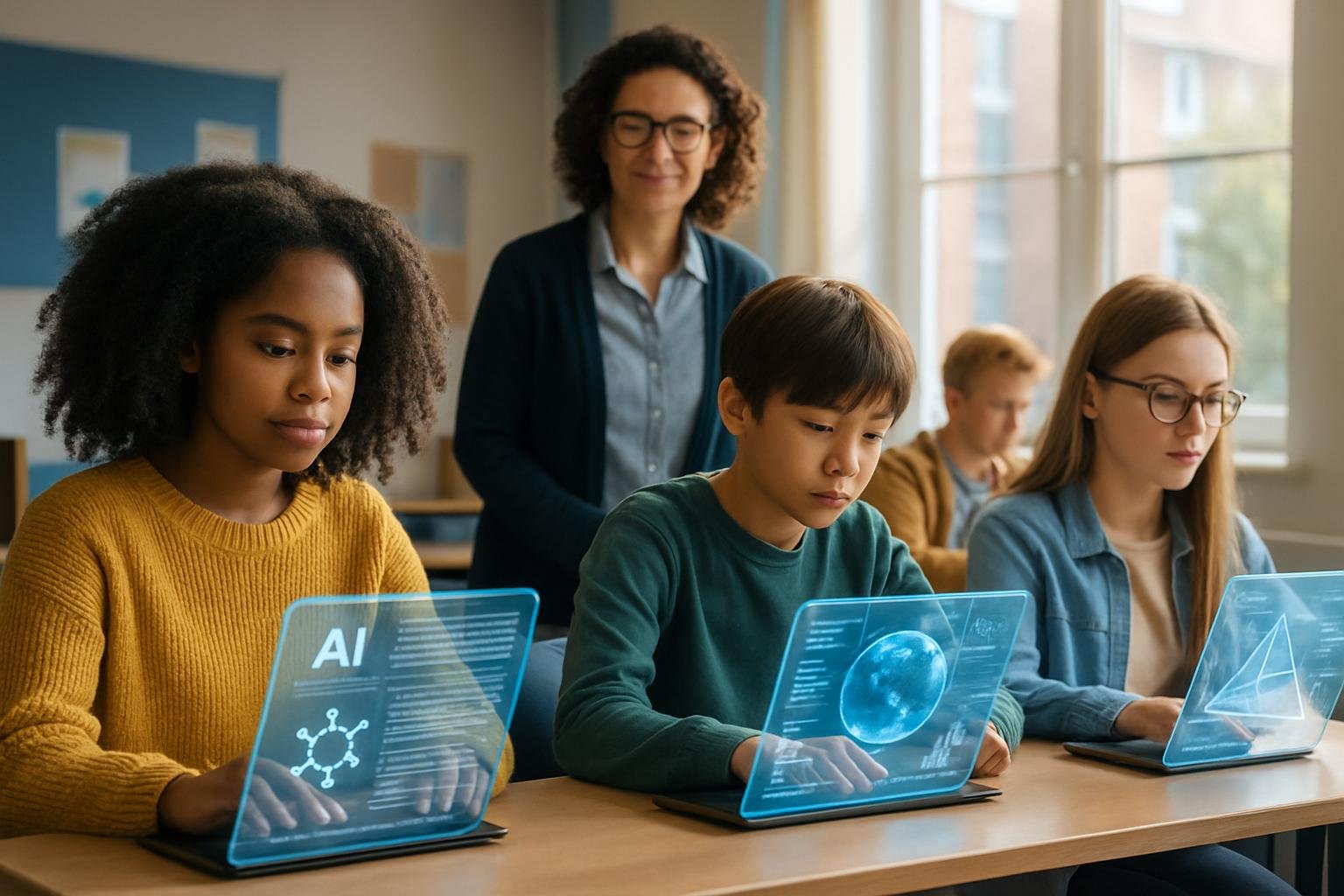
Artificial intelligence (AI) is changing education in American schools and colleges by making learning more personalized, helping teachers save time, and giving students new ways to understand difficult subjects. From elementary classrooms to universities, AI-powered tools are becoming part of conversations about teaching, homework, research, and career preparation. Students can use AI tools to explain complex topics, practice writing, and receive feedback, while teachers can use them to develop lesson plans and create learning materials. However, AI in education also raises important questions about academic honesty, student privacy, fairness, and the role of teachers. Understanding how AI is changing education in American schools and colleges can help students, parents, teachers, and college leaders make better decisions about this technology.
What Is Artificial Intelligence in Education?
Artificial intelligence is technology that can perform tasks such as understanding language, recognizing patterns, analyzing information, and generating text or other content. In education, AI can support students and teachers through tutoring tools, writing assistants, adaptive learning platforms, automated feedback, and virtual assistants.
For example, a student who struggles with algebra can ask an AI tool to explain a problem step by step. A teacher can use AI to create practice questions for different ability levels. A college student can use an AI assistant to organize research notes or review a difficult concept before an exam. These tools can make learning more flexible, but their answers are not always correct. Students and teachers should verify important information and use AI as a learning aid rather than treating it as an unquestionable source. The U.S. Department of Education has encouraged responsible AI integration that supports learning while keeping educators involved in important decisions. https://www.ed.gov/about/news/press-release/u-s-department-of-education-issues-guidance-on-artificial-intelligence-use-in-schools-proposes-additional-supplemental-priority
How AI Is Changing Learning in American Schools
1. Personalized Learning for Students
One major benefit of AI in American schools is the ability to adapt learning activities to individual students. In a traditional classroom, one teacher may have to support students with different learning speeds and skill levels. AI-powered learning platforms can sometimes identify areas where a student needs more practice and recommend exercises based on their performance.
For example, a student who finds reading comprehension difficult may receive extra practice with vocabulary and short passages. Another student who understands the material quickly may move on to more challenging activities. This approach can help students practice at their own pace. However, AI recommendations should not replace teachers’ professional judgment. Teachers understand students’ classroom behavior, emotions, and individual circumstances in ways that software may not.
2. Helping Teachers Prepare Lessons
Teachers spend time preparing lesson plans, writing quizzes, creating worksheets, and adapting materials for different students. AI tools can help with some of these tasks. A teacher might use AI to brainstorm a lesson introduction, generate sample questions, simplify a reading passage, or develop a classroom activity.
This support may give teachers more time to explain concepts, answer questions, and work directly with students. AI-generated content still needs human review because it may contain errors, inappropriate examples, or information that does not match the curriculum. Schools should also make sure that teachers receive suitable training before using these tools. The goal is to use AI to support teachers, not to replace their experience or reduce the importance of human interaction in the classroom.
3. Supporting Students Who Need Extra Help
AI may help students who need additional explanations, practice, or language support. Some tools can explain the same idea in simpler words, provide examples, or help students practice a new language. Speech-to-text and text-to-speech features may also improve access for some learners, depending on the tool and the student’s needs.
These features can be useful in diverse American classrooms, where students may have different educational backgrounds and language abilities. However, AI tools are not automatically accessible or fair to everyone. Some may perform poorly with certain accents, languages, disabilities, or cultural contexts. Schools should evaluate tools carefully and provide alternatives so that students are not disadvantaged if they cannot access or effectively use AI.
The Role of AI in American Colleges and Universities
4. Changing College Assignments and Research
AI is also changing higher education across the United States. College students may use AI tools to brainstorm essay topics, summarize their own notes, understand difficult readings, practice coding, or prepare for presentations. Researchers may use AI-assisted tools to organize information and explore patterns in large collections of data.
Used responsibly, these applications can help students learn more efficiently. However, submitting AI-generated work as if it were entirely a student’s own work may violate a college’s academic integrity policy. Rules differ by institution, course, and assignment. Students should read their instructors’ directions, disclose AI assistance when required, and make sure they understand and can explain the work they submit. AI can support research and writing, but it should not replace original thinking, careful reading, or proper citation of sources.
5. Improving Academic Advising and Student Services
Colleges often provide services such as course registration support, financial aid information, career guidance, and technical assistance. AI chatbots and virtual assistants can answer common questions at any time, helping students find information about deadlines, campus services, or university procedures.
AI may also help advisers organize information and identify students who could benefit from additional support. Yet automated systems should not make high-impact decisions about a student’s future without appropriate human oversight. Information about tuition, scholarships, degree requirements, and financial aid should be confirmed through official college or government resources. AI-generated answers can be incomplete or outdated, especially when rules change.
6. Preparing Students for Future Careers
AI is influencing many workplaces, including business, healthcare, engineering, education, marketing, and technology. American schools and colleges are therefore considering how to help students understand AI and develop the skills needed to use it responsibly.
Students can benefit from learning how AI systems work, how to check their output, how to protect private information, and how to recognize bias. They also need skills that technology cannot replace easily, including communication, teamwork, creativity, problem-solving, and sound judgment. Learning to work with AI may be useful in many careers, but students should not assume that every job will use the same tools or that AI knowledge alone guarantees employment.
Benefits of AI in Education
AI can offer several potential benefits when schools and colleges choose appropriate tools and use them thoughtfully.
- More flexible learning: Students can review explanations and practice skills at their own pace.
- Faster feedback: Some tools can provide immediate feedback on practice activities, allowing students to identify mistakes sooner.
- Teacher support: AI can help teachers brainstorm materials and adapt learning activities.
- Learning accessibility: Certain tools can provide translation, transcription, or alternative ways to access content.
- Research assistance: College students can use approved AI tools to organize ideas and explore complex topics.
- Digital skills: Guided use can help students develop AI literacy and prepare for technology-related changes in the workplace.
These benefits are not guaranteed. Results depend on the quality of the tool, the way it is used, the subject being taught, and the support available to students and teachers. Schools should focus on whether a tool actually improves learning rather than adopting AI simply because it is new. UNESCO also emphasizes that AI in education should support inclusion, equity, and human-centered learning.
Challenges and Risks of AI in American Education
7. Academic Honesty and Overdependence
One of the biggest concerns is that students may rely on AI to complete homework without learning the underlying skills. If a student asks AI to write every essay or solve every math problem, the student may miss opportunities to practice independent thinking. AI-generated work can also contain made-up facts, incorrect calculations, or weak reasoning.
Schools and colleges can respond with clear policies that explain when AI is allowed, when it must be disclosed, and which tasks must be completed independently. Teachers can also use discussions, in-class writing, oral presentations, drafts, and practical demonstrations to better understand student learning. The purpose should be to measure genuine understanding, not simply to catch students using technology.
8. Privacy, Bias, and Equal Access
AI tools may process personal information, including student prompts, assignments, and other data. Schools should understand how providers collect, store, use, and protect this information before adopting a platform. Students should avoid entering sensitive personal details into tools unless the school has approved the use and appropriate protections are in place.
Bias is another concern. AI systems may produce inaccurate or unfair results because of limitations in their training data or design. Access also matters: students without reliable internet, suitable devices, or paid subscriptions may have fewer opportunities to use certain tools. American schools and colleges should consider privacy, accessibility, fairness, cost, and evidence of educational value when evaluating AI products. The U.S. Department of Education’s AI guidance and UNESCO’s recommendations provide useful starting points for responsible adoption.
How Teachers, Parents, and Students Can Use AI Responsibly
AI works best in education when people understand both its strengths and its limits. Teachers should explain acceptable use, check AI-generated materials, and help students develop critical-thinking skills. Parents can talk with children about online safety, encourage them to ask questions about AI-generated answers, and check school rules before allowing AI tools to be used for assignments.
Students should use AI to learn rather than simply to finish work faster. They can ask for a concept to be explained in simpler language, request extra practice questions, or get feedback on a draft they have written themselves. They should verify factual claims, use reliable sources, protect private information, and follow classroom instructions. Schools and colleges should regularly review their AI policies as technology changes and involve educators, students, families, and relevant specialists in decisions that affect learning.
Conclusion
AI is changing education in American schools and colleges by creating new ways to personalize learning, support teachers, assist research, and prepare students for future careers. These tools can make education more flexible and accessible when they are selected carefully and used with clear goals. At the same time, AI creates challenges involving academic honesty, privacy, bias, unequal access, and the accuracy of information.
The future of AI in American education will depend not only on technology but also on the decisions made by teachers, school leaders, families, and students. Human guidance, critical thinking, and meaningful relationships remain essential to learning. By using AI responsibly and checking whether it improves student outcomes, American schools and colleges can benefit from innovation without losing sight of what education is meant to achieve: helping people build knowledge, confidence, and skills for life.